OpenHands Review 2026: Is the Most-Starred AI Coding Agent Actually Good?
OpenHands has 77K+ GitHub stars and a 4.6/5 editorial rating. But stars are not the same as production readiness. Here is our honest take after evaluating it against Devin, Cursor, and GitHub Copilot.
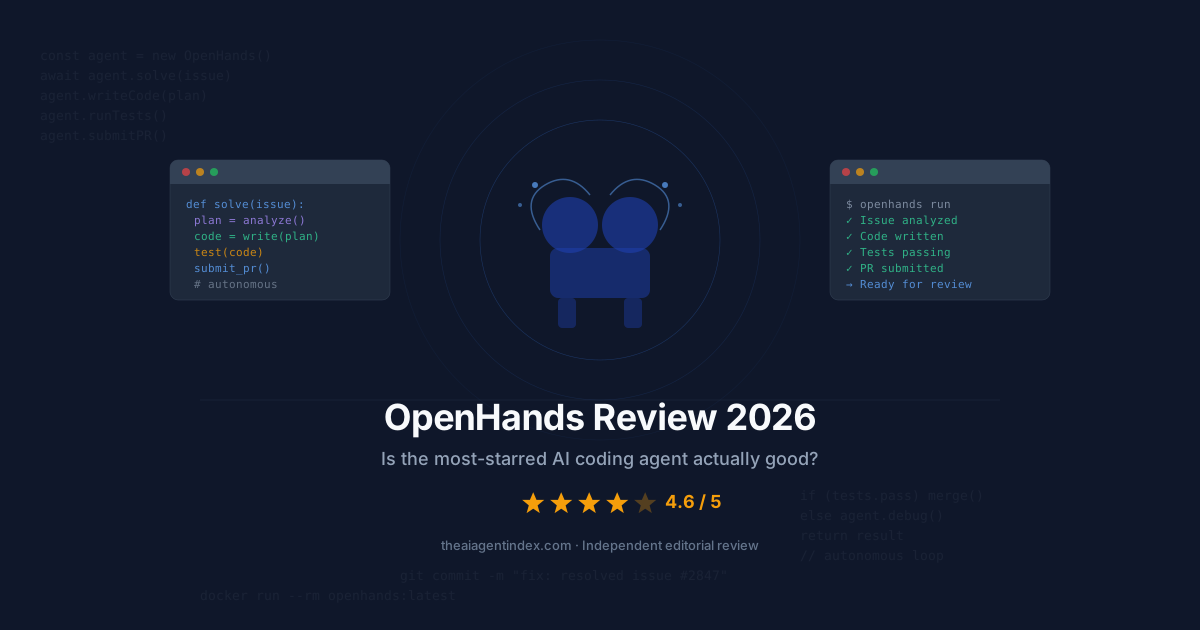
77,000+ GitHub stars make OpenHands the most popular open-source AI coding agent by a wide margin. But popularity and production readiness are not the same thing. We evaluated OpenHands across pricing, autonomous capability, integration depth, and real-world limitations to determine who it is actually built for and who should look elsewhere.
What OpenHands Actually Does
OpenHands (formerly OpenDevin) is built by All Hands AI as an open-source platform for autonomous software engineering agents. Give it a GitHub issue or task description and it plans the solution, writes the code, runs tests, debugs failures, and submits a pull request. The full developer workflow, end to end, without per-step human approval.
The agent operates in a sandboxed Docker environment with access to a terminal, code editor, browser, and file system. It installs dependencies, runs test suites, and iterates until the task passes. It supports Claude, GPT-4o, Gemini, and open-source models including Llama and Qwen through BYOK (bring your own key).
This is not autocomplete. This is not chat-based code suggestions. OpenHands attempts to be a junior developer you assign work to.
Three Ways to Run It
Open Source (free, MIT license): Self-hosted, unlimited conversations, any LLM via your own API keys. You manage Docker infrastructure and compute.
Individual SaaS (free): Hosted at app.all-hands.dev with BYOK or at-cost model pricing. GitHub, GitLab, Bitbucket, Jira, Slack, and Linear integrations included. No seat limits, unlimited daily conversations.
Enterprise (custom pricing): Self-hosted VPC via Kubernetes, Agent Control Plane for running multiple concurrent agents, Large Codebase SDK, SAML/SSO, multi-user RBAC, budgeting enforcement, and priority support.
The free tiers are genuinely free with no artificial conversation caps, which is rare in this category.
Where OpenHands Excels
Autonomous task completion. For well-scoped issues with clear requirements, OpenHands handles the full loop: reading the issue, planning the approach, writing code across multiple files, running tests, and submitting a PR. We rated its autonomous capability 5/5 in our editorial assessment, the highest score on our rubric.
Model flexibility. Unlike commercial alternatives that lock you into their chosen model, OpenHands lets you bring any LLM. Want Claude for complex reasoning tasks and a cheaper model for simple fixes? You can configure that. MCP support is included on all plans.
Transparency. MIT license, published SWE-bench results, and active development with 77K+ stars. You can inspect every line of code the agent runs, audit its decision-making, and contribute improvements upstream. No commercial coding agent offers this level of transparency.
Where It Falls Short
Task scoping matters enormously. OpenHands works best on bounded, well-specified issues. Vague requirements like "refactor the authentication system" will produce partial or incorrect solutions. Treat it as a capable junior engineer, not a senior architect. Every PR needs human review before merging.
Enterprise features are gated. Multi-user RBAC, SAML/SSO, centralized billing, and the Large Codebase SDK all require custom Enterprise pricing that is not published. Teams that need these controls cannot evaluate cost without a sales conversation.
Self-hosting is real work. Running OpenHands at team scale means managing Docker infrastructure, provisioning compute, and handling API key rotation across your team. Compare this to Devin or Cursor where infrastructure is fully managed.
How It Compares
vs Devin: Devin is the fully managed commercial alternative at $500/month per seat. You get managed infrastructure, SLAs, and a polished UI. OpenHands gives you the same autonomous capability for free (self-hosted) or at model cost only (SaaS), but you trade away managed infrastructure and enterprise support. For teams comfortable with open-source tooling, OpenHands delivers comparable autonomous coding at a fraction of the cost.
vs Cursor: Different tools for different workflows. Cursor is an AI-enhanced IDE where you write code alongside AI assistance. OpenHands is an autonomous agent you assign tasks to. Cursor excels at interactive pair-programming; OpenHands excels at batch task completion. Many teams use both.
vs GitHub Copilot: Copilot focuses on in-editor completions, chat, and code review across the broadest IDE coverage in the category. OpenHands focuses on end-to-end autonomous task completion. Copilot is the safer enterprise default; OpenHands is the more capable autonomous agent.
Our Verdict
We rate OpenHands 4.6/5 in our editorial assessment, making it one of the highest-rated agents in our AI coding agents directory. The autonomous capability is genuine, the pricing is unbeatable, and the open-source transparency sets a standard the commercial alternatives cannot match.
The catch: you need to scope tasks carefully, review every PR, and (if self-hosting) manage your own infrastructure. Teams that treat OpenHands as an autonomous junior developer with proper code review processes will get enormous value. Teams expecting a fully autonomous senior engineer with zero oversight will be disappointed.
Bottom line: If your team is comfortable with open-source tooling and can provide clear task specifications, OpenHands is the most capable free AI coding agent available today.
Explore the directory
Search, filter, and compare AI agents across eight business categories.
Browse AI Agents